
Hydraulic Transfer Molding Presses for Rubber and Insert Molding
A transfer molding press forces preheated material from a pot into a closed mold under hydraulic pressure. Because the tool closes before the material moves, transfer molding holds tighter dimensional control than compression molding and handles intricate geometry, deep sections, and metal inserts that compression molding struggles with.
French designs and builds custom hydraulic transfer molding presses at its Piqua, Ohio plant for rubber, silicone, thermoset, and composite molding operations. Every press is engineered around the part, the material, and the cycle rather than selected from a fixed model list.
How a Transfer Molding Press Works
Transfer molding sits between compression molding and injection molding. It gives up some of injection molding's cycle speed and takes on some of compression molding's simplicity, and in exchange it delivers dimensional control and part complexity that neither alternative matches at low to medium volume.
Material is preheated before it reaches the mold cavity, which shortens cure time. It is then driven into the closed mold in one of two ways: by a hydraulically operated plunger, or by the compressive force of the press acting on tooling that contains an internal transfer pot.
Plunger and Cold Pot Transfer
Plunger transfer uses a dedicated hydraulic cylinder to drive the transfer ram independently of the clamp. That decouples transfer pressure from clamp tonnage and gives the process engineer separate control of both.
Cold pot transfer holds the pot below cure temperature so material stays workable until it enters the heated cavity. French built a 250 ton automatic hydraulic vacuum press specifically for cold pot transfer molding of automotive components.
Where a Transfer Molding Press Is the Right Choice
Transfer molding earns its place when part complexity or insert content rules out compression molding, but volume does not justify injection tooling. It suits:
- Mid-range dimensional tolerances
- Low to medium production volumes
- Small to medium sized parts
- Delicately shaped parts with thin walls or deep, small-diameter features
- Low to medium durometer materials
- Colored and translucent compounds
Insert Molding and Overmolding
The transfer process was developed to mold intricate products containing small deep holes or numerous metal inserts. Because the tool is fully closed before material transfers, insert shift is limited compared to compression molding, where material and mold close on the inserts together.
This is the strongest single argument for a transfer press in automotive, electrical, and sealing applications where a bonded metal-to-elastomer interface has to hold position.
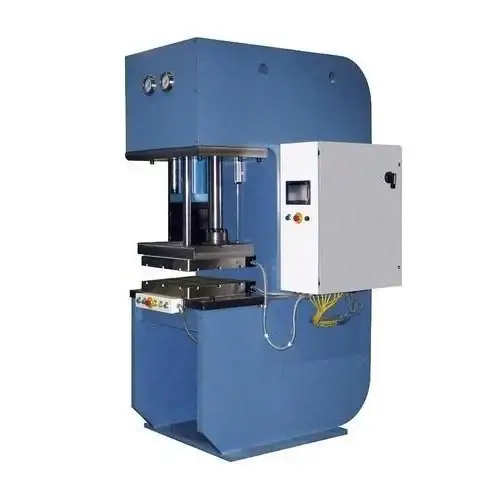
C-frame transfer molding press for molding neoprene rubber products
Transfer Molding vs. Compression Molding
Where Transfer Molding Wins
- Shorter production cycles than compression molding
- Closer dimensional tolerances than compression molding
- Consistent results from cavity to cavity in multi-cavity tooling
- Faster mold setups
- Less flash, because the cavity plates are already closed when material enters
- Lower labor cost per part in multi-cavity tools, since only one preform is loaded
Trade-Offs to Plan For
- Higher total investment than compression, counting press, tooling, and auxiliary equipment
- Requires a preform, meaning a pre-measured slug of material
- Generates some material degradation during transfer
- Not suited to high durometer compounds
- Higher tool maintenance cost than compression. Cavity wear is lower than injection, but gates and runners erode
- Higher labor content than injection molding
- Flash pad and pot pad are scrap
Scrap from the pot pad and runner system is a recurring cost, and it is worth sizing against your material spend before committing. A die trim press downstream can recover some of that labor.
Resin Transfer Molding for Composite Parts
Resin transfer molding is a separate process that shares the transfer name. RTM is a low-pressure closed molding process, typically under 100 psi, that produces dimensionally accurate composite parts with a high-quality finish on both surfaces. Liquid thermoset resin is drawn or injected into a closed mold containing dry fiber reinforcement.
Materials commonly processed by RTM include epoxy, vinyl ester, methyl methacrylate, polyester, and phenolic resins, reinforced with glass, aramid, carbon, or synthetic fiber. Note that filled and reinforced materials belong to RTM, not to rubber transfer molding, where filled compounds are generally a poor fit.
French builds presses for both processes. If your application is composite molding, the press requirements, platen heating, and control strategy differ substantially from a rubber transfer press.
Automation and Controls
Presses can be supplied with material feed automation, part removal, and recipe-driven controls with cycle data logging. Automation content is specified against the part and the volume rather than bundled as a package.
Related configurations include the rubber molding press and the TMP Asian molding press line.
Service and Support from the Original Manufacturer
French has built hydraulic presses in Piqua, Ohio since 1900. TMP, Technical Machine Products, has been part of French since its acquisition and has built presses and mixing equipment since 1978. Both product lines are supported by the same engineering and service organization.
That includes OEM parts, field service, and press rebuild and retrofit on machines that have been in service for decades. Customers in more than 80 countries run French equipment.
Frequently Asked Questions
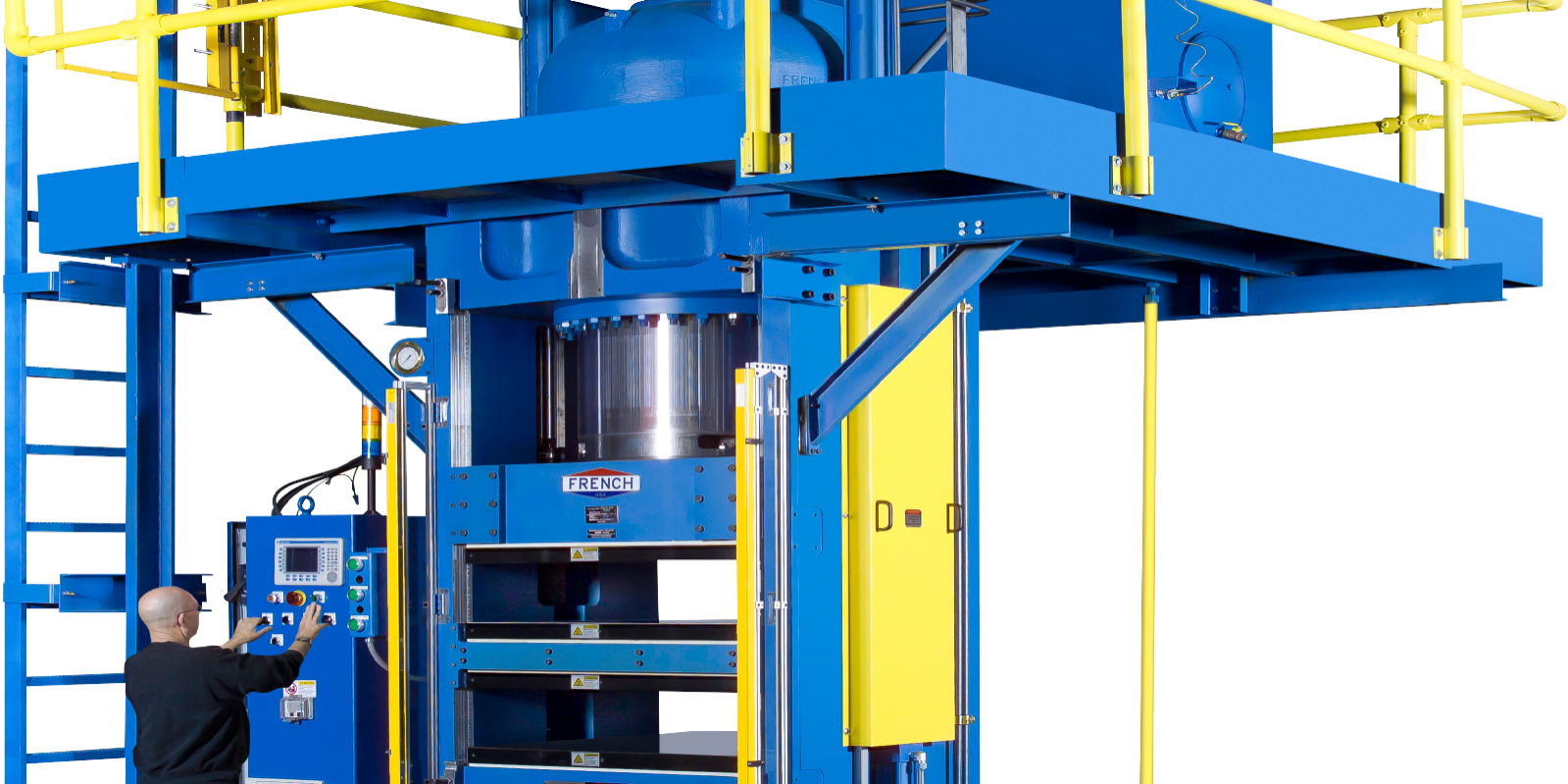
Service & Support
Hydraulic Press Support Since 1900 | OEM Parts, Repairs, Rebuilds, Retrofits, and Field Service
Request a Quote
Tailored Solutions for Your Manufacturing Needs: Achieve Optimal Process Results with Our Customized Equipment and Specialized Solutions.